by Noha El Maraghi
I love the Lebanese accent. It has more of a melody than other accents in Arabic. The last vowel is always prolonged and it sounds more like music. As an Arabic speaker I was looking forward to hearing the accent because I think it’s very pretty and some of the words are different. Egyptian Arabic is not the standard by any means, but almost all people in the Arab world understand it due to its popularity through the Egyptian movie and music industry. So everyone understands me perfectly and vice versa although some words are different. I've really enjoyed translating for the group, especially when it comes to Katie reading menus in the beginning. The Lebanese accent is especially pretty when coming from this little boy called Faris who I was originally going to do my story on. He's about 6 or 7 years old with the cutest face and smile. His hair is jet -black and geled back with a comb. His small stature is almost as tall as the white bucket of red roses he carries around to sell to people. What is peculiar about him is unlike other kids on the street he still seems to have innocence. He walks around Hamra district in the wee hours of the night looking freshly groomed and as he goes from restaurants to bars the girls flock to him and buy his flowers and hug him and pinch his cheeks. While guys idle by waiting for the hogger of attention to leave. We always wonder why this poor kid is not tucked into bed at 8 pm as we see a bucket of flowers float through a sea of giants compared to him. His courage as a child when he holds his ground about the price of a rose is astounding. But no one would dare to bother him because he is close buddies with the business owners who are always keeping an eye out for him. Also we’ve seen an older child around 10 years old sometime waiting for him outside restaurants and escorting him. Every time we see Faris we yell Hi Faris! He stops and talks to me in his cute accent saying confidently hi, how are you, are feeling well? With innocence and perfect composition from this child I’m overwhelmed by his cuteness and sad that he has to do this job.
Monday, August 2, 2010

Saturday, July 31, 2010
What's Next?
By Christopher Robbins
One of the most disturbing problems with Lebanon is the outlook of the people here. Whenever you ask about the future, the answers are predictable – war, whether from Israel or within, and then a period of rebuilding.
I can’t blame the people here for feeling that way. Since 1920, Lebanon has only had 17 years of peace. Here we are eating like kings and drinking like a fish on the battlefield of the Arab world. That may be why the Lebanese favor big meals and strong drinks, they never know when the tenuous peace will collapse and their country will slide into another conflict.
What you don’t often hear when asking Lebanese about the future is any plans – no plans for infrastructure. No plans for the advancement of civil liberties. No plans for secularization.
Lebanon lives for today.
Lebanese leaders are so busy trying to solve the problems of their confessional system and trying to remain engaged in the politics of the Middle East that very little attention is paid to where Lebanon is going as a country.
Apparently it has been that way here for a long time. The roads are choked with congestion. Adel Nayfeh, our guide, driver and friend, described being stuck on a highway for 4 hours just to travel 27 miles. Beirut’s narrow, crooked streets are bumper-to-bumper madness for allof the day and most of the night.
Lebanon’s density and small size make it ideal for passenger rail. The city of Beirut itself is starved for a functional bus system, light rail or a metro. Either of these systems would take cars off the road and reduce air pollution.
Clearly the Lebanese and the foreigners here are spending money, almost every block has a construction project where a new state-of-the-art building is going up. Even in the mountains and the Beka’a, new residential and commercial developments are going up almost everywhere you look.
No zoning laws control where and how these buildings are erected. Green space is disappearing rapidly and many families occupy structurally unsafe houses and apartments.
Lebanon may be weak, but it is far from a poor country. No disincentive exists against doing things cheaply and poorly.
People here can pay taxes to fund Lebanon’s future - money seems to flow freely here.
But a lot of people don’t bother to pay, and there are few enforcement mechanisms to follow up with Lebanese citizens who owe. No disincentive exists which motivates people to pay.
The water system is deficient – water from the taps is untreated and undrinkable, often salty because of the proximity to the sea. In small towns well water is generally drinkable, and some mountain villages have fresh mineral water flowing from natural springs through fountains.
In Beirut and along the coast clean water and the disposal of wastewater are problems. Wastewater is often dumped directly into the ocean. There are few laws governing the safe disposal of waste products, and the ones that exist are poorly enforced.
There are police here but it is not clear what their function is beyond clearing a lane in the road for government officials and visiting dignitaries to drive down. Occasionally an officer might be seen writing a ticket for double or triple parked cars, but generally the police are nowhere to be found. Security for government officials is provided by the army.
Lebanese drivers even ignore traffic lights.
Beirut will never resemble Dubai or Doha, Qatar as long as the government does not take responsibility for coordination and regulation.
How do you plan for the future with so few and such weak institutions of state?
It is no wonder that Lebanese people are reluctant to talk about their future – war could come at any time as sectarian conflict and oligarchical powers regularly deadlock the government. Yet Lebanon survives.
It doesn’t progress. It just survives.
Friday, July 30, 2010
Past, Present and Future
By Ashley Westerman
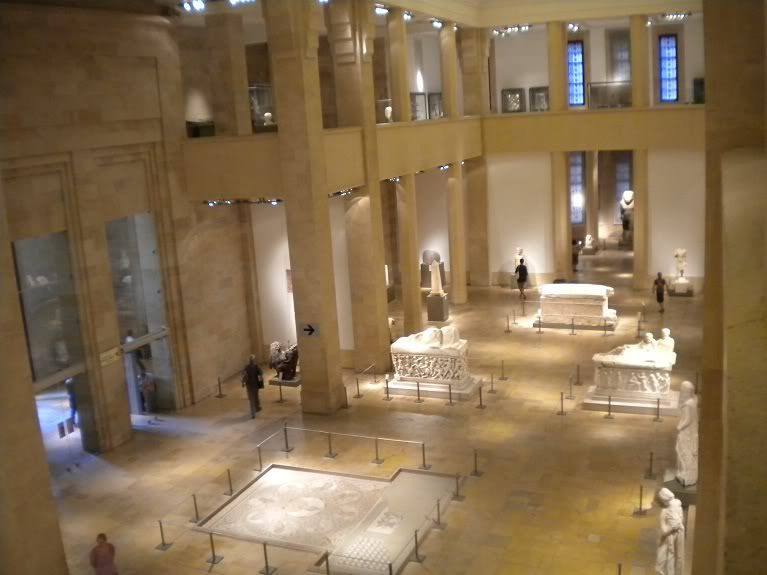
The museum was only two stories; the third floor was currently under renovation but it hosted a certain aura of grandeur that demanded our respect regardless of its size. In comparison to, say the Smithsonian Museums in Washington DC, this museum held very few artifacts. I had respect for this museum; as I do with with most but this was different. I’ve seen many museums throughout the United States and throughout the world, but I particularly liked this one because of its simplistic displays and easy navigation. But in retrospect, I would much rather spend an hour or two in the National Museum taking the time to read all of the signs and awe at the “few” (only 1,300 objects of its 100,000 collection) ancient artifacts than breezing through the 100s of clusters of exhibits in the Smithsonian in fear that I may not get to see all of it in one day.
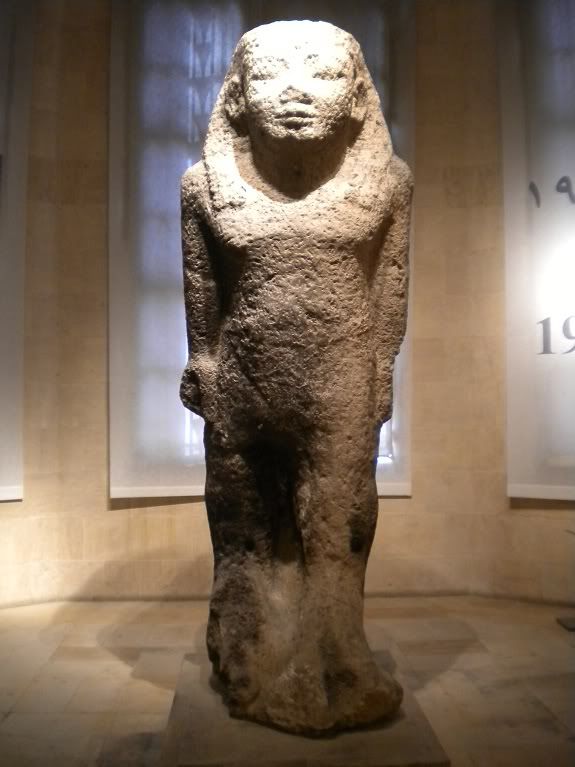
The National Museum definitely had a good mix of artifacts both big (sarcophagi, mosaics) and small (jewelry, weapons). I think my favorite floor of the two was the first floor that had all of the larger stone artifacts such as statues and thrones. My favorite statue, Colossus, was in the Egyptian-inspired section:
The upper floor housed the smaller artifacts. I really liked a lot of the jewelry, figurines and other small objects archeologists have discovered within the borders of Lebanon over the years.
For more pictures of the National Museum – as well as pictures of Moukhtara Palace, home of Walid Jumblatt – click HERE.
Before we left the second floor of the museum, one of my classmates pointed out a very interesting display that required I take a second look. Inside the small glass case appeared to bit bits and pieces of different artifacts sloppily fused together; these were some of the artifacts that were damaged during the Lebanese Civil War. After further investigation, I learned that the National Museum lay on the actual line that divided the waring factions – called Museum Ally – and was actually very badly damaged during the war. Many of the artifacts had to be removed, while the heavier ones were eventually encased in wood and concrete to protect them from the shelling and bombing happening around the museum. In 1991 after the Civil War, the restoration of the museum was headed by the Ministry of Culture and Higher Education.
Currently collection on the floor is only about 1,300 objects as mentioned above. However, the museum is divided neatly into the following sections: Prehistory, Bronze Age, Iron Age, Hellenistic Period, Roman Period, Byzantine Period and the Arab Conquests. I like my museums to have a bit of organization so I really enjoyed being able to “step” through history. The basement is scheduled to open up in November of 2010.
I am very glad that we took the time to get to see the museum and I’ve always had deep respect for those who wish to preserve the past. I also think that the National Museum is a symbol of the nationalism that Lebanon strives today to achieve. Even the rhetoric used on the signs in the museum conveys a sense of nationalism, a wanting to be united as one Lebanon despite the current political situation. I will admit that it has been very difficult for me to wrap my head around the idea that Lebanon has a future as, well, one Lebanon, as a unified state where the people are more proud to be Lebanese than Christian or Muslim or Druze. And I think the museum is a good way to see that even from different pasts – as most countries come together from – Lebanon can still be united now and for the future.
IN OTHER FASCINATING MIDDLE EASTERN NEWS…
It has recently been discovered in my own dorm room that present-day Egyptians are still connected so deeply to their ancient Pharaoh roots that they tend to sleep like this…

Look familiar?
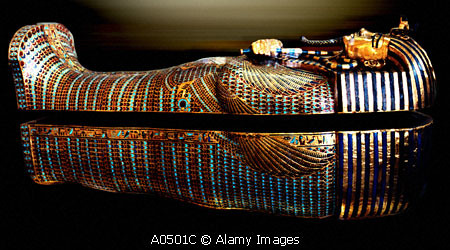
**Thank you to my beautiful and wonderful Egyptian roommate, Noha, for being such a great sport about this post.

Wednesday, July 28, 2010
Learning from Language

By Katie Perkowski
A couple days ago when I went to pay to enter the AUB beach, the man working at the entrance saw me hand him a 20,000 bill (it cost 3,000 LBP for a day) and started asking me something in Arabic. I’ve only learned a handful of basic words, greetings and phrases since being here the last few weeks, and of course, none of the things he was saying to me sounded familiar. I figured he was asking me if I had any smaller bills, but I didn’t know for sure, so I just stood there looking helpless and stupid because I didn’t know what to say to figure out how to solve the problem. Then out of the corner of my eye, I saw a young man who I hoped could help me.
After looking from me to the employee and back again, he realized we could not communicate with each other, and then translated the Arabic to English for me. Then I told him I didn’t have any change and to ask if I could get the change later. The unknown translator said something to the employee, handed him 3,000 LBP, and walked in the beach as the employee waved me in too. I still don’t really know if the translator paid for me or if the man let me in for free, because the translator walked in so fast that I couldn’t thank him or ask him what he said.
Either way, this experience taught me how important it is to learn different languages.
In high school, for some idiotic reason I took three years of Latin. If you asked me to say anything in Latin, the only thing I could say is “semper fi,” and I could maybe translate a sentence or two from a first-year book. So as you can see, it did a world of good for me. When I came to college, I signed up for Spanish 101 but quickly became overwhelmed because we had translating assignments in the first couple days and I didn’t even know basic vocabulary words. I quickly opted out and took two semesters of linguistics (which proved to be very interesting and enlightening) instead.
This summer I have done study abroad trips to India and Lebanon, and have been to stops in between on layovers, and I must say that I have often times felt very little and stupid because I only know one language. I have heard people speak three different languages within a span of five minutes. When I ask them why they know so many languages, they always say it is abnormal to not speak at least two. Now I know in the states it is different because we are not surrounded by a bunch of different countries and different languages, but I think to gain a better international education and understanding, and to also better-equip students for future business endeavors, a stronger emphasis needs to be placed on foreign language — earlier and longer in America’s school systems.
This summer I have done study abroad trips to India and Lebanon, and have been to stops in between on layovers, and I must say that I have often times felt very little and stupid because I only know one language. I have heard people speak three different languages within a span of five minutes. When I ask them why they know so many languages, they always say it is abnormal to not speak at least two. Now I know in the states it is different because we are not surrounded by a bunch of different countries and different languages, but I think to gain a better international education and understanding, and to also better-equip students for future business endeavors, a stronger emphasis needs to be placed on foreign language — earlier and longer in America’s school systems.
Of Surface and Substance
By Ralph Schoellhammer
One of the most striking first impressions of the city of Beirut is its modern, almost Western appearance. Sure, traffic is chaotic and traffic signs are not more than friendly suggestions, but that is just about the same in every Italian city south of Rome. If we see Americanization as the strongest form of Westernization, Beirut is even further ahead than some European cities. Try to find a Dr. Pepper, a KFC or even a single doughnut in Vienna and you will realize that it is a futile endeavor. Not so in Beirut, where they sell them at every corner and you literally cannot walk for more than two minutes before finding yourself in front of some US fast food-franchise. Some people like the New York Times columnist Thomas Friedman see this development as the emergence of a global society that on the long run will usher into a new peaceful world order. Warming up to his theory, Friedman created the “Golden Arches Theory”, stating that no two countries which have McDonald’s franchises have ever gone to war with each other. But even before the ink was dry, the Kosovo crisis lead to a NATO air-campaign against Serbia, rendering the “Golden Arches Theory” meaningless.
The existence of a McDonald`s in Belgrade did not make the country more Western, just as the existence of Dunkin Doughnuts in Tel Aviv and Beirut did not prevent the war of 2006. The idea that equal consumption behavior will lead to equal political behavior is as tempting as it is flawed. It is a superficial deception that seems to absolve many contemporary observers and columnists to look deeper into the issues at stake.
If you fly from New York to London and then continue to Berlin you will again have the Beirut experience: The same pop music, the same jeans, the same Cheeseburgers. And yet Europe might be only second to the Arab World when it comes to anti-Americanism. The American model of “Imperialism” (for the lack of a better word) was deliberately based on this superficial deception. It is quite peculiar that the United States never saw a problem in its attempt to change the dinning culture of entire nations, but backed off almost every time when it comes to deeper things like the form of governance or questions of liberty.
The United States became an empire by accident, unwilling to fully take up the responsibility that comes with being the world’s strongest state. The British Historian Niall Ferguson remarked that the US is “an empire that lacks the drive to export its capital, its people and its culture to those backward regions which need them most urgently and which, if they are neglected, will breed the greatest threats to its security. It is an Empire, in short, that dare not speak its name. It is an empire in denial.” It only exported the easy, superficial parts of its culture: Food, music, movies. But those things are the result of American culture, not its precondition. And indeed, this neglect, as Ferguson describes it, has “breed the greatest threats to security”: On 9/11, 15 out of the 19 hijackers were from Saudi Arabia, a country that had a friendly relationship with the United States since the 1930s and, in fact, owns its independence to the patronage of the US. In 1946 Colonel William Eddy was the first United States minister to Saudi Arabia. In his first meeting with Ibn Saud, the country’s founder, he was told: “We will use your iron, but you will leave our faith alone.” Compare this to the story of British India: In the early days of British rule there was the widespread tradition of “suttee”, the burning of widows together with their dead husbands. The British general Charles Napier was observing this tradition and decided not to leave their faith alone: “You say it is your custom to burn widows. Very well. We also have a custom: when men burn a woman alive, we tie a rope around their necks and we hang them. Build your funeral pyre; beside it, my carpenters will build a gallows. You may follow your custom. And then we will follow ours.”
It was an obvious feature of British Imperialism to export its vision of justice and government, and there can be no doubt that modern India is better off without suttee. The political correct mind would probably argue that this is an imperialistic view, but at its time it was called “cultural confidence.”
When the United States, on the other hand, came to Saudi Arabia, they decided to provide 20th century technology to an 8th century ideology. And, contrary to the American model, the Saudis do use their oil money to spread their ideology or show “cultural confidence”. Look at the numbers: In 1974 Saudi Arabia’s exports were to 91% oil-related. In 2004, it was still 91%. So what did they do with all the oil revenue? They train and finance Imams, build mosques spreading the Wahhabi version of Islam, fund the OIC and its attempts to make a public discourse of Islam impossible.
Even those institutions that were built by Americans to teach and educate moved into the backwater of Anti-Americanism. Don’t believe it? Well, in 2004 Professor Galal Amin, a professor at the American University of Cairo, wrote in Egypt's Al-Ahram Weekly, that "there is still doubt that the September [11] attacks were the outcome of Arab and Islamic terror.... Many writers...suspect that the attacks were carried out by Americans." This seeming to be an important observation at AUC, Prof. Amin was seconded by his colleague Abdallah al-Ashal, professor of international law and political science who said during an interview in 2008: “I claim that since the events of 9/11, which were created by Sharon and Bush - the two of them shared a secret.” The idea, of course, that the mere existence of schools and better education will eliminate radicalism, terrorism and political violence is regularly contested by reality. The Wall Street Journalist Daniel Pearl was beheaded by a graduate of the London School of Economics, the London subway bombers were university students and fully integrated into the British society – fans of Fish’n Chips, Cricket and soccer. You can loathe Western society and still enjoy the seductions it has to offer – from pornography (the main preoccupation of Mohammed Atta besides plotting the 9/11 attacks) to Pepsi and Rod Stewart (the passion of Mullah Omar). But while it is understandable that the more radical Islamists denounce the West and try to spew their propaganda, it is surprising that the West itself does not seem to realize the problem at all. It is nice when the US-Ambassador in Beirut proudly announces that the US is the largest donor to UNRWA and builds schools throughout the Near- and Middle East, but, unfortunately, has no influence on the curriculum of these schools. Sure, I forgot: Lebanon and all these countries are sovereign nations and they do not want foreigners to interfere in what they teach at school. Fair enough, so the United States is not a sovereign nation? Ever heard of the Islamic Saudi Academy in Virginia? Or its most well known graduate, Ahmed Omar Abu Ali who tried to assassinate the US-President in 2005? Probably not, because all major news outlets from the AP to the New York Times declined to mention some background details on the school that turned Mr. Abu Ali into a radical. Described as a mere “high school” by the New York Times, a closer look might have revealed additional information. For example that the school describes itself as “subject to the government of the Kingdom of Saudi Arabia” or that its classes are based on “the curriculum, syllabus, and materials established by the Saudi Ministry of Education.” Luckily for the school’s pupils, the Saudi Ministry of Education offers a straight forward curriculum concentrating on Wahhabi history and “Islamic values and the Arabic language and culture” and, of course, “the superiority of Jihad.” Part of this educational experience is that in 11th grade students are taught that on the final day of judgment Muslims will kill every Jew on the planet, and one can only guess how beneficial the view of the “Saudi Ministry of Education” is on Christianity and the West, given that even the possession of a Bible constitutes a crime in Saudi Arabia. In other words: While America finances schools in the Arab world that teach the loathing of the West, Saudi Arabia finances Schools in North America that teach the loathing of the West. To a certain degree, one is reminded of the old cold war joke where the American tells his Soviet friend: “This is a free country; everybody is allowed to criticize our president.” His friend answers: “Same here, in the Soviet Union everybody is allowed to criticize your president.” In a certain way, radical Islam has been a more successful export product than McDonalds: Pakistan adopted Islamic Law in 1977, Iran in 1979, Sudan in 1984. In 1960, Nigeria had English Common Law, now half of the country is under Sharia law, fighting a bloody war with the half that is not. Even in NATO-occupied Afghanistan a person trying to convert to Christianity has to face death threats. It is not the caves Tora-Bora that threaten the success in Afghanistan; it is in the classrooms of Kabul where the outcome of this conflict is decided. The Duke of Ellington famously said that “the Battle of Waterloo was won on the playing-fields of Eton,” if so, the battle against radical Islam might as well be lost in the backyards of the madrassas. If the West is not willing to present and defend an alternative ideology, more and more people will start looking for one elsewhere.
The Soviet Union failed in the end because the majority of Eastern Europeans wanted to live like their Western brothers and sisters. In the view of Poles, Czechs, Bulgarians and all the other formerly Communist nations, Western Democracy was the future, not Soviet Communism. In other words, it was the battlefield of ideas that in the end brought down the Soviet system. The question now is, how are we doing on this battlefield in the Muslim World? Not so well, I would guess: If we look at current trends, a large number of people between Morocco and Indonesia see their future in an Islamic society under Sharia law. A view that is, by the way, shared by an increasing number of Muslims living in the West. The difference is that in the 80s there actually were several institutions from the Catholic Church to NGOs like Helsinki Watch (now known as human rights watch) who actively promoted Western values. Nowadays, however, every attempt to do the same in the Muslim World is denounced as Imperialism, Colonialism or even Racism.
According to the UN’s demographic division in 1974 the Muslim World represented about 15% of the global population and the Western World accounted for approximately 30%. In 2004, both are at an almost equal 20%, with the latter in population decline while the former shows strong population growth. So I would suggest that the political views and philosophical principles the strongest growing demographic group on the planet ascribes to might have some impact on what the world looks like a few generations down the road. History is usually made by the most determined, and not the so-called silent minority. Neither the Nazis in Germany, nor the Bolsheviks in Russia ever won a majority in an election. Their determination, however, brought them to power anyway.
To leave the field to the radicals in the Muslim World, no matter under which name they appear, would mean to abandon all those millions of believers who just want to go on with their daily lives, raise their children and have a sense of security. In light of the most recent decision by Western governments to abandon Afghanistan in 2014, we might want to rethink the signals we are sending to the world. If we are not willing to defend our values and beliefs, why should they.
Back Into Purgatory, Part 3
By Christopher Robbins
Muhammed abu Sayd lights a cigarette and takes a long drag off of it. His lightly wrinkled face and bald head give testament to long years lived – he came to Lebanon from Palestine at the age of 4 months, but still his heart yearns to return. Everyone I meet in Bourj al-Barajneh shares this wish.
We sit in the courtyard/dining room/living room of his home on plastic patio chairs around a plastic patio table. We are served strong Arabic coffee and breakfast and have a polite political conversation, asking questions about Palestinian civil rights and the infrastructure conditions at the camp.
After an hour abu Sayd lowers his voice and asks us what we think. My co-explorer, Noha, is speechless so I make an attempt to fill the void.
“I think I am ignorant – I have heard a lot, I have been taught a lot, but seeing these conditions with my own eyes has changed my perspective,” I say.
“In America, on Fox News and CNN they think the land is not ours and that we are all terrorists,” saays abu Sayd.
“Not everyone believes what they’re told,” I say.
Abu Sayd puts out his cigarette and looks at me with a smile, eyes narrowing. The heat of the day is descending upon us like a wet blanket – I see beads of sweat collecting in the wrinkles of his face.
“In 1982, when the Israelis came, I fought them,” says abu Sayd.
He then lays a whole story of horror out on the table before us, a banquet of the ugly truth right where we had just shared breakfast and coffee. He took up arms to resist the Israeli invasion of Lebanon, a campaign that was largely directed at Palestinian militants and civilians living in the camps in Lebanon.
Abu Sayd was wounded in action and taken prisoner by the Israelis. He was taken to a hospital for treatment but his wounds were not closed. He points to scars on his arm, on his face, and a dent in his balding head.
“Here is where they shot me,” says Abu Sayd.
As a wounded prisoner, before being taken to the hospital, he was kicked and beaten by the soldiers. He describes arguments between the soldiers, debating whether they were doing the right thing. One of the soldiers trying to defend him from the savagery gave him a cigarette after his beatings.
In the hospital bed he was drugged and questioned repeatedly about militant activity in Lebanon and the Palestinian resistance against Israell. His wounds were left open and Israel intelligence men prodded them, twisting muscle and sinew with scissors and other instruments in an attempt to produce the right amount of pain to make him talk. He points again to the large scar running up around his bicep into his arm pit. They tried psychological measures, too, threatening to abduct his wife, his sister and his children and rape them in front of him.
After three days of interrogation, the Israelis took all of his statements and destroyed them, accusing him of lying. Blind in one eye, writing in pain, he said he would tell the Israelis anything they want.
Abu Sayd had no information to give the Israelis.
They then gave him an injection, meant to be lethal, and threw him outside to the dogs.
“I got lucky,” says abu Sayd. “They traded me for dead bodies, it was arranged by the Red Cross.”
I ask him if he hates Israel, if he hates Jews.
“I don’t hate Jews, I hate the Israelis,” says abu Sayd. “We lived in harmony and peace with Arab Jews for many years. They were our friends and our neighbors, but these Europeans and Russians came and stole our land from us and killed our people. With Jewish Palestinians, we are like cousins.”
“Anyone is obliged to carry a rifle and go get his land back. No matter what age.”
That seems to be the prevailing opinion among the residents of the camp. It is a kind of purgatory where these people wait amidst their suffering, frozen in time for 62 years pining for their land and their rights to be restored, enduring tragedy after tragedy.
Deeper into the camps, we meet Amina Hassan Banat, a careworn woman in a small but beautiful home. She has a heart condition so we do not stay long, she shows us her medications, Plavix, Lopressor – costing her over $100 a month after assistance. She receives some assistance from the Martyrs Association and other Palestinian organizations.
After prayer she invites us in to sit on comfortable couches. In her hands is a picture of 4 young men, her sons. Her living room is covered with pictures of her sons.
One morning in 1982 her family finished eating breakfast when there was a knock on the door. After being forced to leave Palestine they settled in the Sabra and Chatila refugee camp in Beirut, Lebanon. It is there, on the morning of Sept. 17, that the soldiers came for them.
Mrs. Banat tells her story through a torrent of tears and sobs. The soldiers, who spoke Arabic with a Lebanese accent, entered the house and asked what their nationality and religion were. Upon being told they were Palestinian Muslims, the soldiers collected the 4 boys and their father outside onto a truck. It was the last time Mrs. Banat saw her children.
Over the years stories came from freed prisoners about her children, but none confirmed their survival. She still lives in hope that they are alive somewhere. Mrs. Banat keeps a picture of them in every room in her house, so she is always by their side.
Noha and I try to ask her about electricity, about Palestinian rights.
“My mind is not with politics at all – it is with my chidren!” exclaims Mrs. Banat.
It has been 28 years since she has seen her children.
The eldest one, Aziz bin Faisal Dirawi was 31 years old
Ibrahim bin Faisal Dirawi was 25.
Mansour bin Faisal Dirawi was 22.
Ahmed bin Faisal Dirawi was 13 when he disappeared.
They shot her husband in the head.
We leave Mrs. Banat to her tears, and her pictures on every wall of every room of her house. We walk out past murals of al-Awqsa mosque and anti-Israeli graffiti. Faded pictures of Former PLO Chairman Arafat smile at us from almost every building. Here in Bourj al Barajneh, the smiles are fading…
…and after 62 years, time is running out for those who remember when there actually was a Palestine.
OHHHHH...C-A-T-S! CATS! CATS! CATS!
By Ashley Westerman

The ladies add a little Wildcat flavor to Byblos.
Subscribe to:
Posts (Atom)